
October 19, 2026
The Tenant You Haven’t Met Yet: Electrical Design for Flexible Industrial Buildings
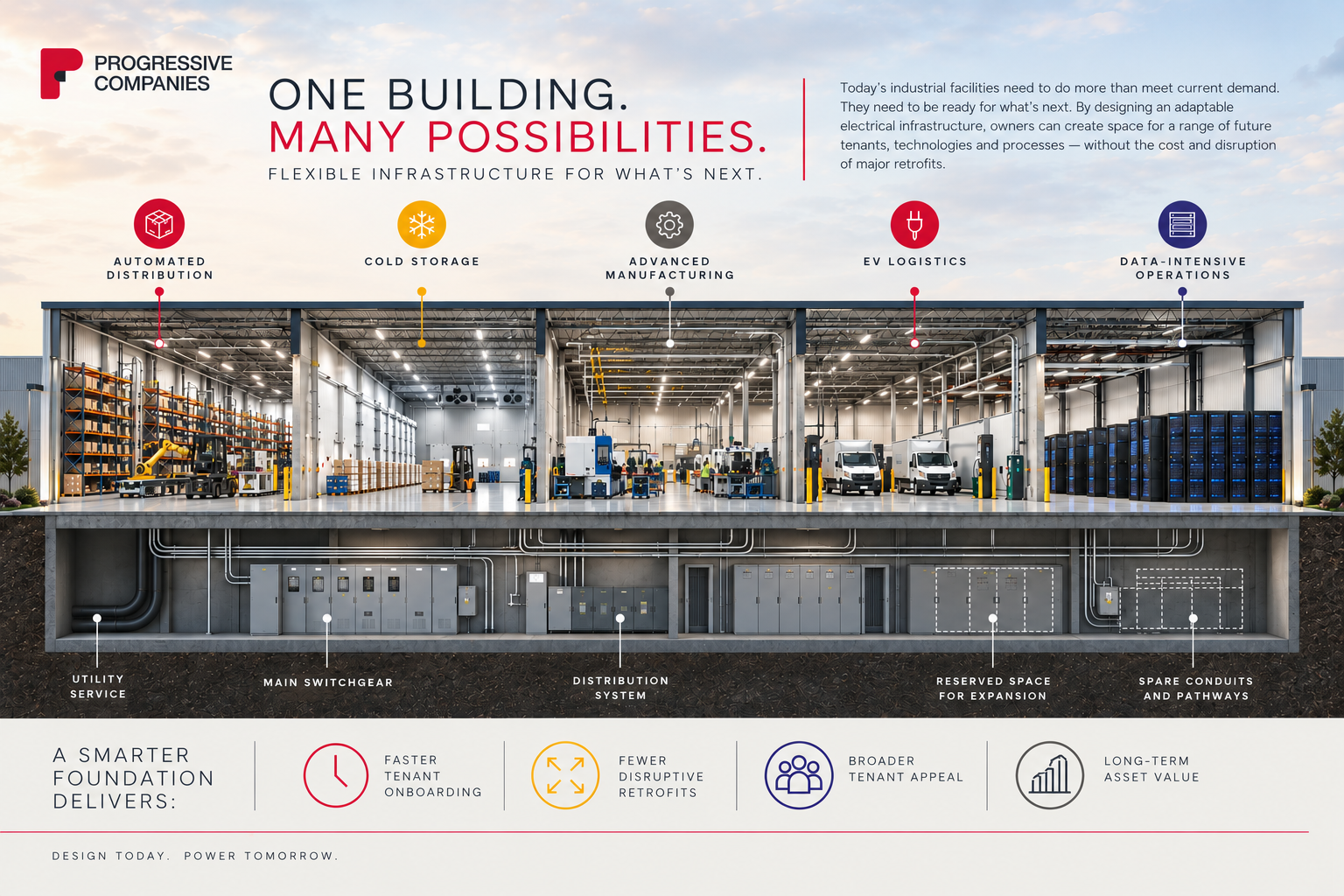
One of the most important concepts of designing a modern industrial building is not sizing the equipment you know today. It’s planning for the equipment that has not been selected, the manufacturing process that has not been defined, and the tenant who may not even exist in the project pipeline yet. This truth poses the ever-present question: how do you design infrastructure for a building when the eventual occupants are unknown, and may change multiple times over the facility's life?
For developers, owners, and investors, this question has become increasingly important as industrial facilities evolve from traditional warehousing into highly automated distribution centers, advanced manufacturing plants, cold storage facilities, data-intensive operations, and electrified logistics hubs. The answer is not to design for every conceivable future scenario. Doing so would be prohibitively expensive. Instead, successful projects balance current economics with future optionality by creating an electrical infrastructure framework that can adapt as tenant needs evolve.
Why This Matters Right Now
This is not a hypothetical planning exercise. After a decade of nearly flat consumption, U.S. electricity demand grew 2.1 percent annually over the past five years, and the Energy Information Administration's Annual Energy Outlook 2026 projects installed generating capacity will need to grow 50 to 90 percent by 2050 to keep pace. That growth is already reshaping site selection: CBRE's 2026 market outlook now lists power availability alongside labor and transportation access as a primary location factor. For an owner courting the next tenant, reserved capacity can be the deciding factor in whether a deal closes.
The Challenge: Flexibility
A tenant-specific facility is relatively straightforward from an engineering perspective. The design team understands the process loads, equipment schedules, operating hours, and growth plans. Utility service, transformers, switchgear, feeders, and distribution equipment can be sized with confidence.
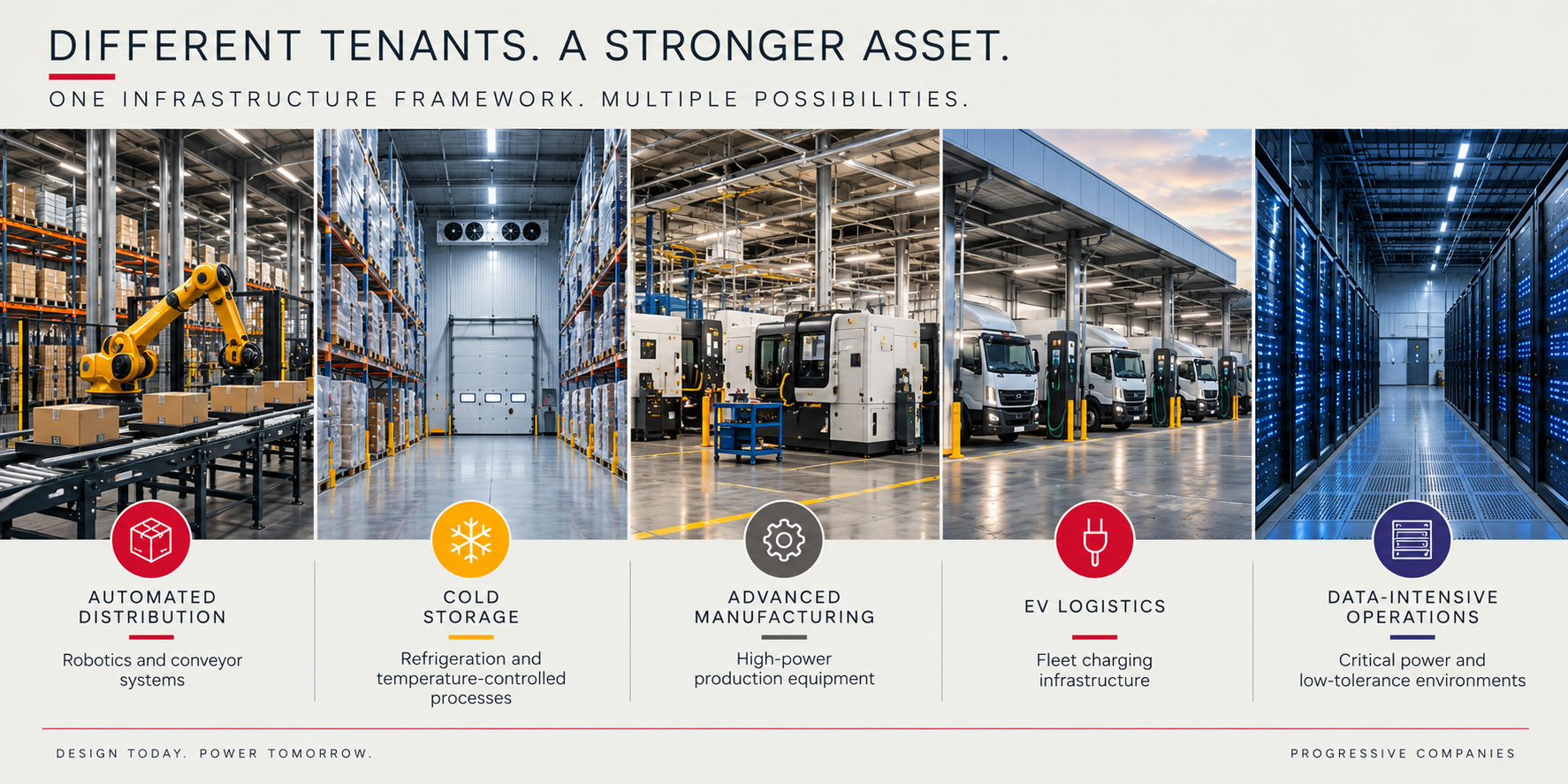
Speculative industrial developments are different. The eventual tenant may require:
- Robotics and conveyor systems.
- Refrigeration or cold-storage processes.
- EV fleet charging.
- Advanced manufacturing equipment.
- Data processing infrastructure.
Each use can create dramatically different load profiles, demand characteristics, and power quality requirements. Future flexibility and expansion capability have become critical design considerations, because owners often do not know the final equipment package or operational requirements during initial design.
The engineering objective therefore shifts from designing around known loads to designing around a range of plausible future loads.
Designing Flexible Electrical
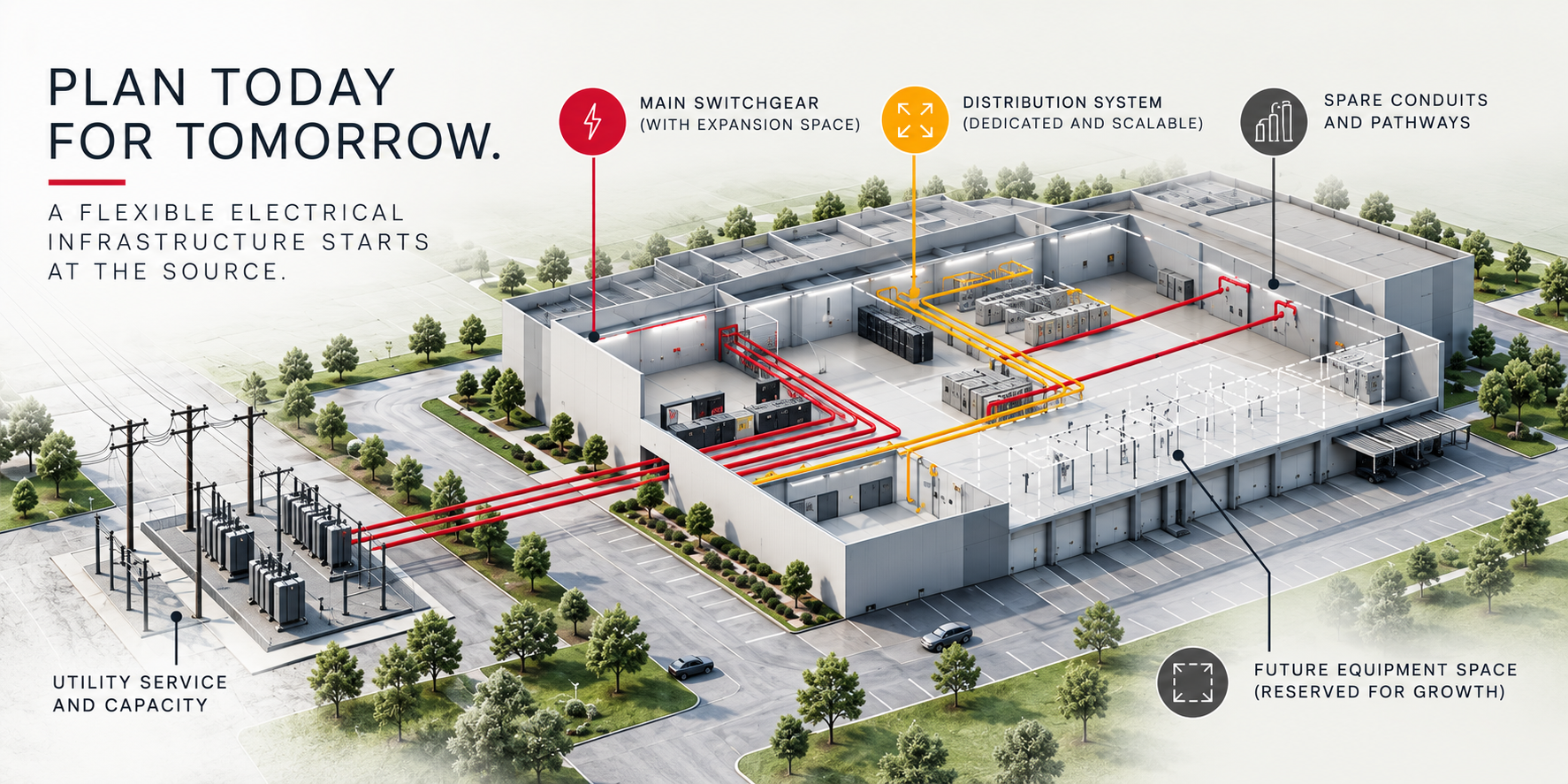
When engineers design for uncertainty, the focus moves beyond connected load calculations and into infrastructure strategy. It starts at the source.
Start with Utility Capacity
An initial consideration is often not how much power the building needs today, but how much power the site could reasonably need in the future.
Early coordination with the serving utility helps establish:
- Available capacity.
- Potential future service upgrades.
- Substation constraints.
- Long-term utility expansion plans.
- Service voltage options.
With utilities experiencing growing demand from manufacturing, automation, electrification, and data centers, obtaining additional power years after occupancy may be significantly more difficult than securing capacity during initial development.
Create Expandable Distribution Systems
Rather than fully building out future capacity, engineers often design systems that can be expanded with minimal disruption.
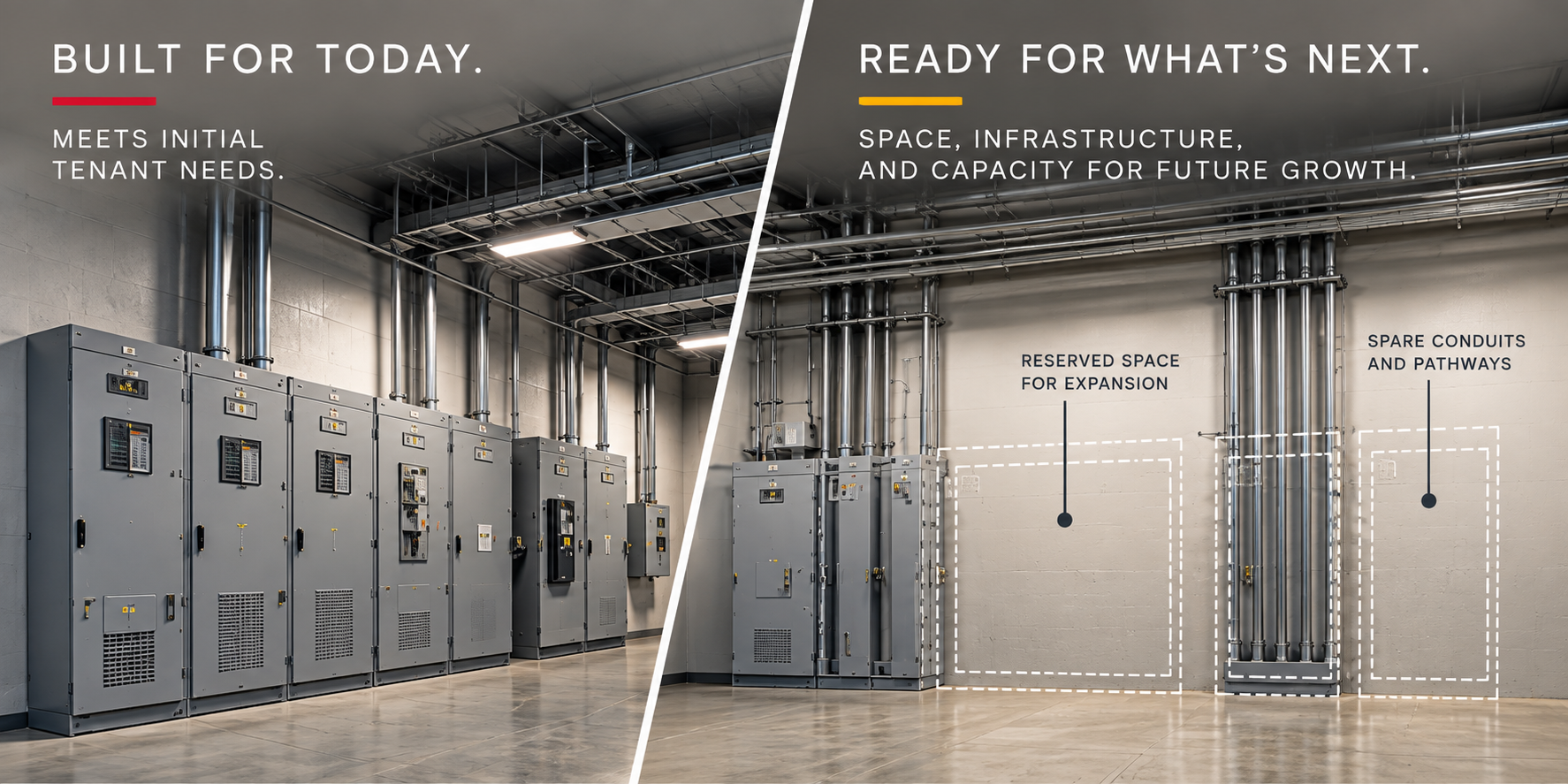
Typical strategies include:
- Reserving future space for expansion in distribution equipment.
- Providing spare conduits and cable pathways.
- Reserving electrical room floor space for future growth.
- Designing busway systems that have both physical and future electrical capacity.
- Locating equipment outside of dedicated electrical rooms at spacings that allow transition of multiple tenants or uses without disrupting adjacent occupancies.
The goal is to avoid tearing apart occupied spaces when future loads emerge. Expansion capability is especially valuable because large electrical equipment often carries lengthy procurement timelines.
Plan for Electrification and Automation
Industrial electricity demand continues to increase as facilities adopt automation, electrified processes, advanced controls, EV charging, and smart building technologies. The Energy Information Administration reported that national electricity consumption reached a record 4.20 trillion kilowatt-hours in 2025, with growth expected to continue through 2027.
Design teams should evaluate:
- Future EV charging infrastructure.
- Battery storage opportunities.
- Rooftop solar readiness.
- Demand management technologies.
- Power quality considerations.
- Backup power requirements.
These features do not need to be installed immediately, but preparing the infrastructure can significantly reduce future costs.
Single-Purpose vs. Flexible Industrial Facilities
Owners frequently face a strategic decision: optimize the building for one known use or invest in flexibility for future users.
Single-Purpose Facilities
A facility designed around a specific process often delivers the lowest first cost and highest operational efficiency for that intended use.
Advantages include:
- Lower initial capital investment.
- Optimized equipment sizing.
- Reduced unused capacity.
- Higher efficiency for the targeted operation.
- Simplified maintenance.
The downside is that future adaptation can become expensive. A facility designed around a single manufacturing process may require substantial upgrades if a new tenant introduces automation, electrification, or significantly different power densities.
Flexible Multi-Tenant Facilities
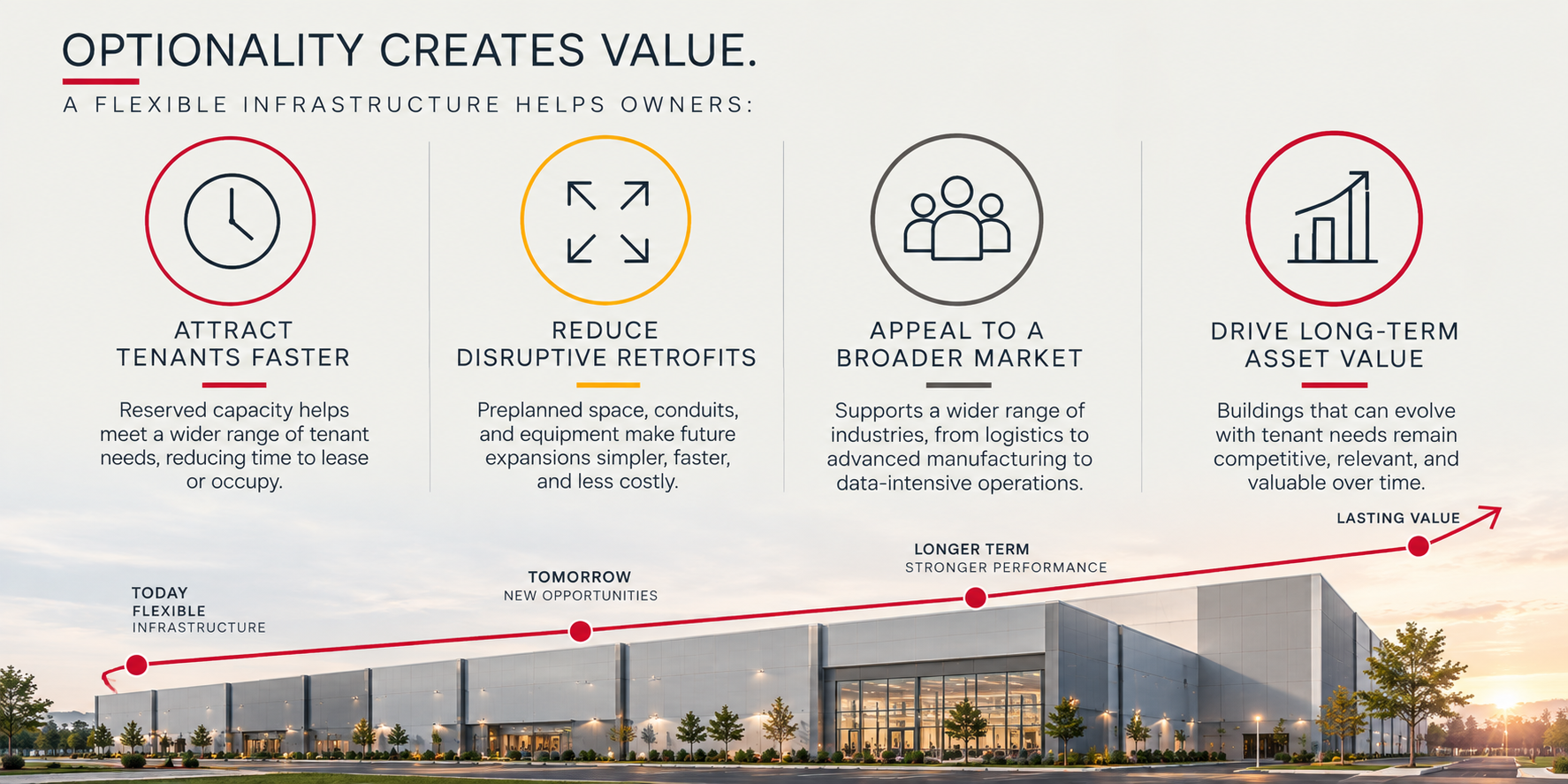
Flexible facilities intentionally incorporate excess infrastructure capacity and expansion pathways.
Advantages include:
- Broader tenant appeal.
- Faster tenant onboarding.
- Reduced future retrofit costs.
- Greater adaptability to changing markets.
- Improved long-term asset value.
The tradeoff is higher initial investment. There may be more cost for utility service capacity, electrical room space, conduits, switchgear provisions, structural accommodations, and distribution infrastructure that is not immediately utilized.
However, many developers view this additional investment as a form of risk management. In markets where tenant requirements evolve rapidly, flexibility can help preserve building competitiveness throughout its lifecycle. CBRE's 2026 industrial outlook found that third-party logistics providers, who typically need shorter lease terms and more flexible space, are expected to account for more than a third of this year's leasing activity.
What This Means for the Balance Sheet
For owners and investors, the payoff shows up in three places. Buildings that flex across use types tend to lease up faster, since the buyer pool is not limited to one process type. Lenders increasingly treat expansion-ready infrastructure as a value driver rather than a sunk cost. And owners with documented spare capacity have real negotiating leverage, answering a prospective tenant's power questions immediately instead of restarting utility conversations mid-negotiation.
Designing for Optionality
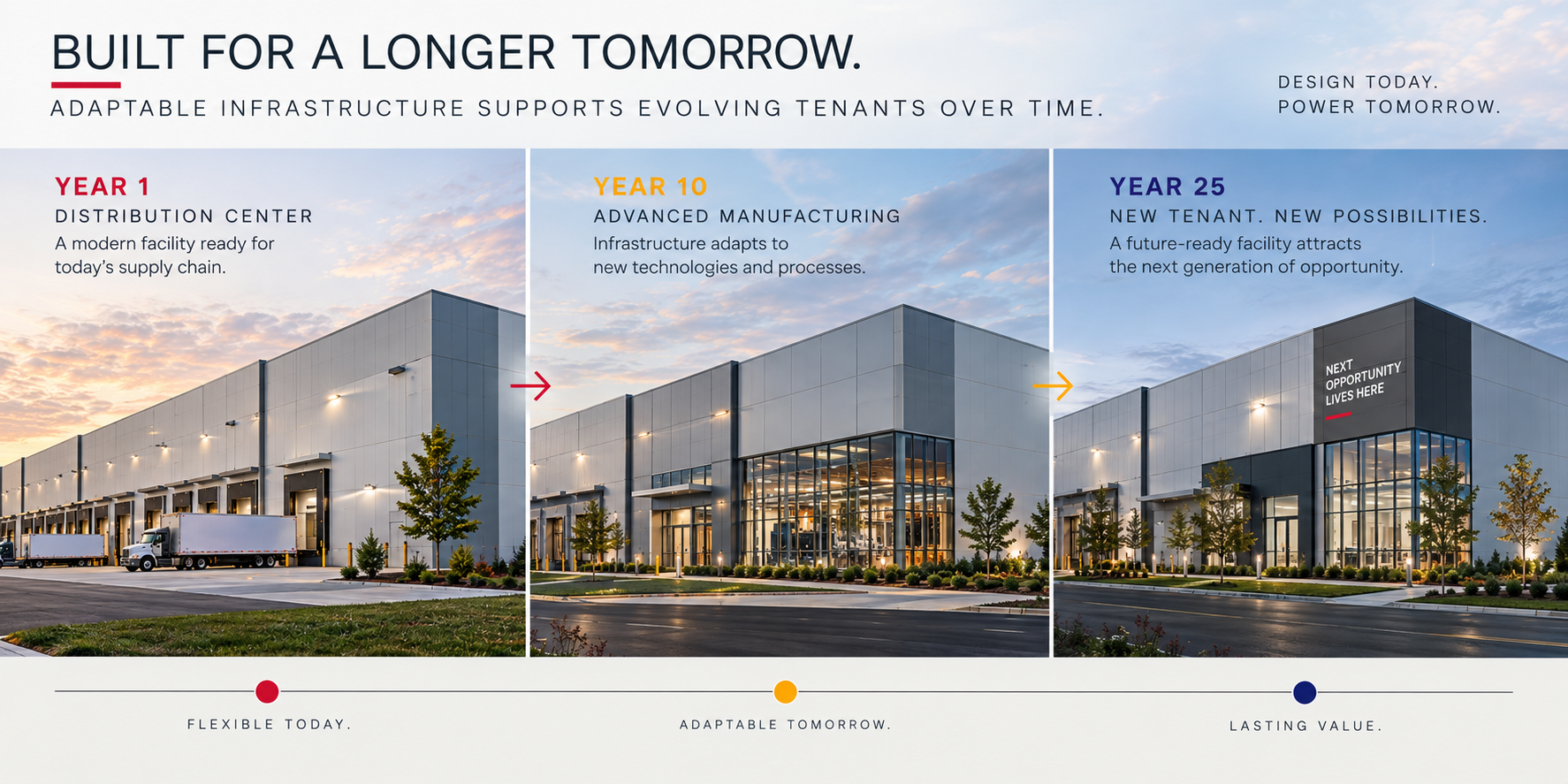
The most successful industrial facilities are rarely the cheapest to build or the most heavily overbuilt. They are the facilities that strike the right balance between today's economics and tomorrow's uncertainty.
Good engineering does not attempt to predict every future tenant. Instead, it creates a platform capable of supporting future possibilities.
That means evaluating utility capacity early, reserving expansion space, designing flexible distribution systems, and identifying strategic investments that reduce future disruption.
In an era where automation, electrification, and industrial power demands continue to evolve, optionality is becoming one of the most valuable design criteria an industrial facility can possess.
The Bottom Line
The tenant you have not met yet is, in a way, the only tenant that matters when the building is being designed. Every dollar spent reserving capacity or running a spare conduit is a bet that flexibility will be cheaper than a retrofit, and that bet usually pays off. The facilities that hold their value over a 20 or 30 year life are rarely the ones engineered perfectly for day one. They are the ones built to say yes to whoever walks through the door next.
Questions Every Engineering Team Should Be Discussing
- How much additional utility capacity is available beyond our initial design load?
- What future tenant scenarios are most likely for this facility over the next 10 to 20 years?
- Have we reserved sufficient space for future electrical distribution equipment for future tenants to be minimally invasive when those tenants are identified?
- Can the building be easily subdivided or consolidated for future occupants?
- What infrastructure should be installed now to support future automation or EV charging?
- What electrical upgrades would be most disruptive after the building is occupied?
- How can the electrical design improve both tenant flexibility and long-term asset value?
Learn more about our Science, Industry & Technology Expertise


